With the suspension of Cincinnati Reds pitcher Edinson Volquez for performance enhancing drug use and a swirl of rumors that the agent involved was clomiphene (also known as Clomid,) I thought it timely to write about how clomiphene works and how it’s used. From what I read on the internets, there is an enormous amount of misinformation floating around out there.
To understand how clomiphene works, you need to know how the pituitary controls the making of testosterone in the testis. Testosterone is made by Leydig cells in the testis, which I explained in my last post. The pituitary releases a hormone called luteinizing hormone (“LH”) that stimulates the Leydig cells to make testosterone. Testosterone is converted to the female hormone estrogen, (which I also explained in my last post,) and estrogen tells the pituitary to stop making more LH. This kind of negative feedback system is common when it comes to how hormones work. It’s just like a thermostat and heater. As the room gets warmer, the thermostat sends less electricity to the heater. When the room gets colder, the thermostat sends more electricity to the heater.
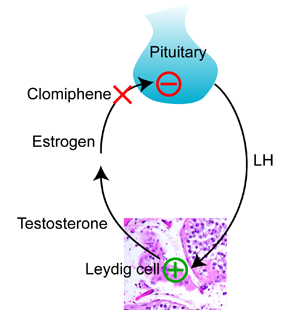
Clomiphene works by blocking estrogen at the pituitary. The pituitary sees less estrogen, and makes more LH. More LH means that the Leydig cells in the testis make more testosterone.
As I explained in my last post, giving testosterone to a man does just the opposite. The pituitary thinks that the testis is making plenty of testosterone, and LH falls. As a result, the testis stops making testosterone, and the usually high levels of testosterone in the testis fall to the lower level in the blood.
So clomiphene is a way to increase testosterone in the blood and the testis at the same time. It preserves testis size and function while increasing blood testosterone.
Unfortunately, clomiphene is not FDA approved for use in the male. Like most of the medications that we use to treat male fertility, the pharmaceutical company that originally sought approval by the FDA did it for women. Clomiphene is now generic, and it’s unlikely that anyone will pony up the hundreds of millions of dollars necessary to get it approved for the male. That’s the bad news. The good news is that it means that this medication is fairly inexpensive, cheaper than most forms of prescription testosterone. Can a doctor prescribe clomiphene for a man? Yes. It’s “off label”, meaning that it’s not FDA approved for use in men.
As a medication, clomiphene is usually well tolerated by men. In my experience, most patients don’t feel anything as their testosterone rises. Those that do feel an increase in energy, sex drive, and muscle mass, especially if they work out. Very rarely I’ve had patients report that they feel too aggressive, or too angry. Very very rarely (twice in the last 20 years) I’ve had patients report visual changes. That’s worrisome, as the pituitary is near the optic nerve in the brain, and visual changes suggests that the pituitary may be changing in size. Because the skull is a closed space, it’s alarming if anything in the brain changes in size. In the last twenty years, I’ve also had two patients who had breast enlargement (called “gynecomastia”) while using clomiphene. Needless to say, for any of these problematic side effects, the clomiphene is discontinued.
So that’s the story with clomiphene. It can be used in the male, either for fertility or low testosterone levels. It’s an off label prescription drug. It works, and is usually well tolerated by men who take it.
 Subscribe by RSS
Hi Dr Niederberger,
Thanks for this great blog.
I would like to throw some questions if you don’t mind and I will be pleased to have your opinion.
“In my experience, most patients don’t feel anything as their testosterone rises. Those that do feel an increase in energy, sex drive, and muscle mass, especially if they work out” Do you mean that if the chief complaint is low Testosterone related absent libido won’t improve in most patients on clomiphene?
Do young (below 30) patients with high total Testosterone and LOW FREE Testosterone improve with Clomiphene (low to absent libido as a chief complaint )?
Why in your opinion do they have this imbalance or discrepancy between total and free testosterone? I mean what causes this sudden and acute drop (usually they describe it as over night or a switch that suddenly turned off) in the FREE portion of Testosterone? even if the reason is high SHBG, why does it happen that rapid and sharp?
Hi Dr Mo, tests for free testosterone vary in quality. We use total testosterone, sex hormone binding globulin, and albumin to calculate the bioavailable testosterone. You can find a calculator at http://www.issam.ch/freetesto.htm. The reason that bioavailable testosterone may be low is if sex hormone binding globulin is increased. Many factors determine sex hormone binding globulin levels, and it is an area of active research.
Hi Dr Niederberger,
Do you typically require an MRI before prescribing Clomid? Is there any concerns with taking it prior to having an MRI?
It all depends on the patient. Each man is different, and I treat each one according to his specific needs.
After reading the post on Clomid, my understanding that this drug is used for men with secondary hypogonadism since it affects the blockage of estrogen at the pituitary.
Is this a correct interpretation?
What affect, if any, does the drug have for those with primary hypogonadism?
Hi Doug, great question. My preference isn’t to label hypoandrogenism (low testosterone) as “primary” or “secondary” but rather to say whether the pituitary or the testes or both are involved, and then it makes it more clear how to diagnose and treat the condition. So if the pituitary is working but under the weather, then drugs like clomiphene or the aromatase inhibitors (read my posts and the comments section on those if you’re interested) can work. Similarly, if the testis is a little under the weather and the pituitary hasn’t responded as vigorously as it might, then these drugs can work as well. Hope this helps.
I have Klinefelters Syndrome . I am using a compounded testosterone. Recently, my dosage was increased to 75mg per day and after 6 months my T level only increased 20ng/dl (481-501) but my total estrogen doubled from 110 to 221.
Saying “working but under the weather” is a little misleading. My testis produce a minimal T output (>100ng/dl). I was thinking that the estrogen blocking drugs would produce more LH and I already have too much.
Hi Doug, I really feel for you. I’m really sorry, but I can’t address personal questions about your own health. Please read the FAQ.
Hi Doctor,
You mention in your article that in your experience, most men don’t feel anything as their testosterone rises.
I guess I’m a bit confused about that- isn’t the whole point of taking clomid to address the symptoms of low testosterone? For example, if one were experiencing ED because they had low T, they would want to be able to achieve erections if the Doctor prescribed clomid to address their problem.
Thanks for helping me understand!
That’s a great question, Mocha. Testosterone controls many body functions in men (and likely in women,) and different problems may arise if it is too low. A man might have problems with fertility but have no problems with energy or erections, for example.
Can this be used for low and abnormal sperm count?
Thankyou
Hi Joanne, that’s a deceptively simple and really great question with a very complex answer. It’s answered in many different ways throughout this blog. I’d encourage you to read other posts about how sperm is made, etc., and especially the many comments, as there’s so much good information in what other people have asked and in answers to those questions.
Hi Doc,
I have two questions actually.
1. Is there a specific time of day you recommend your patients take clomid (e.g. morning evening, empty stomach, after eating etc).
2. Is there a dose you generally start them on or a certain range you use to start with? I have ready mainly either 25mg or 50mg and wondering if with that dosage its effective at all.
Thanks for a great post!
Hi Tim, no specific instructions as the half life of the medication is relatively long. You can learn about that and dosing at http://www.maledoc.com/blog/2010/07/06/doctors-corner-clomiphene-rx/. I encourage you to read the other posts on this blog and especially the comments, as many questions are answered and there’s great information there.
Hello Doctor,
I have 3 questions.
If a patient is on clomid & his testosterone levels are increasing.
1. When does he stop using the drug ?
2. What happens after he stops taking the drug ?
3. How does the patient control the increasing estrogen levels ?
Hi Rahul, he sees a doctor to care for those things 🙂 I also encourage you to read the other posts on this blog and especially the comments, as many questions are answered and there’s great information there.
Hello doctor,
I was reading about some studies with clomiphene citrate. One performed with rats, reports the increase in weight of the pituitary gland (+ 80%), the liver and the adrenal glands, using relatively high doses compared to those used in humans (2mg / kg / day).
What do you think about this, compared to lower doses used in humans? This weight gain cited in the study can be dangerous if it occur in humans?
Hi Saulo, see my post on dosing clomiphene here. I encourage you to read the other posts on this blog and especially the comments, as many questions are answered and there’s great information there.
Hi
If someone was born with bilateral undescended testicles that were descended surgically when he had already developed beared and mustaches, and was diagnosed as NOA, had high FSH, high LH and very low T, do you think Clomid or Drugs like anastrozole and testolactone may be of some help in finding few sperms in ejaculate or in mTESE.
regards
Hi Zehra, such a person with such a specific history would best be seen by a qualified doctor who could work with him and prescribe medications as they are needed. Please read the FAQ.
Hi everybody, I’m sorry, but if you’re asking personal questions about your own health or someone else’s, I can’t answer them. Please read the FAQ.
thanks very much for the great information
I understand that clomid primary used for ovulation induction
but also can be used in men for the following:
low libido
low testosterone level
low sperm count
low energy
muscles building*
gynecomastia
not sure about insulin resistant
is there is any other indication or off label use of clomid ?
at the level of GP /family physician can I prescribe the medication off label to my patient ?
what the ratio of testosterone( free or total ) to estrogens in male according to their age, and what type of estrogens we measure in male ( oestrone , oestradiol , oestriol )?
Thanks a lot
David
Hi David, for the first set of questions, yes, if they’re caused by low testosterone. Libido, for example, is complex and involves more than just hormones. Sometimes the only way you can figure it out is to correct testosterone and see if the patient improves. Gynecomastia, no, that can be an effect of the medication, usually related to estradiol increasing, so it is something you’d want to look out for in a patient. If you are a qualified generalist, just like any medication, you can prescribe it (with an off-label discussion with your patient,) monitor effects, and involve a specialist as the need arises. A standard commercially available estradiol assay is all that is needed, and I generally use a threshold of 50 pg/mL rather than the ratio in my own practice over which I would modify therapy, such as change to an aromatase inhibitor. Take a look around the rest of the blog and especially the comments, as there’s good information in there. I even wrote a post just intended for physicians prescribing the medication. Follow me on Twitter as Craigni for more up to date information if you’re interested.
Does clomiphene cause hair loss in men
Hi Gregory, if a man has the right (or wrong, depending on your point of view) genes for it, testosterone converted to dihydrotestosterone at the hair follicle kicks out the hair. So increasing testosterone, which is what clomiphene is intended to do, may accelerate that process. The medicine per se does not “cause hair loss”, rather, it may hasten an existing process. Don’t forget to follow me on Twitter.
Dr. Niederberger,
Thanks for this informative post. Have you tried using CC in conjunction with testosterone replacement therapy for patients with extremely low testosterone and / or poor results from TRT alone?
Thanks,
Dr. D
That’s a FAQ 🙂
Hi. Thanks for the blog and the info. I have a question. Have you ever seen–or heard of–a link between clomid in men and hypercoagulation?
I’m a 53-year-old man. I took clomid (25mg every 3 days) for a few years but recently stopped because I had a serious episode of DVT with a clot in the lung and one in the heart.
I have read here and there on the internet about the possibility that in some men clomid spurs production of estrogen, which in turn causes clotting. But these were not expert sources.
Any input would be greatly appreciated. Thanks.
I’m sorry, Tom, but I can’t answer personal questions about your own health. Please read the FAQ.
Hi Dr.
I’m wondering if you’ve ever seen clomid prescribed for frequent urination and ED.
Also in your research, has it shown that LH and T levels stay consistent after slowly getting off of clomid?
Thanks,
Bruce
Hi Bruce, no for urinary frequency, as there isn’t a well established relationship there, but erectile dysfunction can be related to low testosterone, not frequently, but it can be. The second question is one that I’ve answered before: I encourage you to read the other posts on this blog and especially the comments, as many questions are answered and there’s great information there.
Dr.
Would a hydrocele cause the testi to faulter with respect to testosterone production?
Typically, the two conditions are unrelated. But every man should see a doctor, as everyone is an individual, and all things can happen in nature.
Hello Dr.
Do you know if Clomid can hurt liver function. Is there any research on this drug in regards to liver damage ? Just curious, since some drugs are hard on the liver.
Thanks Tom
Any man considering clomiphene should consult his doctor about his overall health. The body is an intricate interacting system.
Nice article, I always wounder how exactly the negative feedback happens..
I’ve been reading that DHT also has negative feedback and using DHT supplementation will result in less secretion of LH and thus less testosterone, however I’m wondering how DHT feedback work knowing that DHT can’t be converted to estrogen !?
Hi Mo, DHT and testosterone are in equilibrium: there is always some of both.
How long does it normally take for the average male with low T to start seeing results if he started at your beginning dosage of 25mg of Clomid daily? I could not find this in the FAQ’s. Thanks!
Hi Kevin, the information on how long it takes before a change in the blood level is observed can be found here. The information on how long it takes to make sperm can be found here.
Hey there! Great info.
In your experience (trying to compare) what percentage of SHBG increase do you usually see in patients 90 days out from adding Clomid to their regimen?
We’re seeing significant increases in our clinic.
Thanks!
Brandon
http://www.lowtnation.com
SHBG increases are rare events. If you are commonly seeing significant increases with clomiphene monotherapy, I would suggest that you submit a report to a journal, preferably in a prospective study.
Just out of curiousity, what will it do to people with normal testosterone levels?
There really isn’t a number that is a “normal” testosterone level for all men: a blood testosterone level for one man may be too high or too low for another. Testosterone is part of a larger system that includes many parts, which are different in every man. (I mention this in several places in this blog: if you’re interested, you should read through the rest of the blog posts and their comments.) Clomiphene does one of 3 things: it usually increases testosterone in a man, but it can have no effect, and infrequently, testosterone may decrease. Choosing the medication clomiphene and monitoring its effect is between a man and his doctor.
Very interesting article!
Could a man with low LH have his LH raised by Clomiphene to the point that LH is over normal range? And would this mean what was once secondary hypogonadism has become primary if testosterone levels start to fall? I read this somewhere and just wanted to know if it was true.
Hi Groz, the typical effect of clomiphene is to increase LH–that’s the way it works. If you’re defining normal as laboratories typically do, by a statistical method, then it often increases more than that. As for names like primary and secondary hypogonadism, I don’t personally find them terrifically helpful, and your question implies why: they don’t explain what’s actually in need of fixing and where in the state of fixing the problem is. I encourage you to read the other posts on this blog and especially the comments, as many questions are answered and there’s great information there.
Great information Dr.
My question is would you recommend clomid for someone with Sertoli cell-Only syndrome?
regards
ibrahim
What seems like a simple question is actually quite complicated: how was the diagnosis of Sertoli cell only syndrome made? In many cases, if it’s just a sample or two from the testis, then there may be a chance that it’s not Sertoli cell only throughout the entire testis. This is exactly why a man needs to see an expert physician in reproductive medicine to evaluate him individually and make recommendations specific to his case.
Does Clomiphene have any sway factors when trying to conceive. Are you more likely to have a boy or girl? I’ve read it sways girl. Is this true?
No.
A very informative article, thanks Dr.
Would you be able to confirm my understanding of this drug and some additional questions please?
1. Dihydro-testosterone is the male body’s answer to rising estrogen levels, correct?
2. Because Clomid does not inhibit the production of estrogen, only prevents the pituitary from identifying it, estrogen levels persist and remain “normal” in the male body as they would otherwise, correct?
3. If the answer to #2 is YES, dihydro-testosterone production would also remain at “normal” levels, correct?
4. Does the male body need estrogen? If it’s production was curbed, would dihydro-testosterone production follow suit?
5. Do you have any concerns with estrogen production reducing drugs being used by men?
1. Not at all. Read the posts on DHT and estradiol. 2. That’s variable in men. Estradiol may rise beyond normal. 3. DHT is formed from testosterone in organs such as hair follicles and liver. There, it may increase with increasing testosterone. 4. Yes, the male body needs estrogen. 5. Read the FAQ. I have concerns about all drugs and patients. Men need to be monitored by their doctors as everyone is different.
I had a look through each of the archived posts but I’m unable to find your posts on DHT and estradoil. Any chance you could give me some direction to help me find them? Thanks!
July 24, 2016. I’m a patient, not a physician.
If Clomid blocks estrogen at the pituitary doesn’t the gland also respond to circulating levels of testosterone in affecting LH production?
What’s the mechanism that sets the thermostat, i.e., the testosterone level the feedback system is trying to achieve and maintain?
Please read the other posts in this blog and especially the comments of all posts, where I address that question in detail.
Thanks, but I read through all the comments and the replies, but didn’t find answers to my two questions!
Maybe it’s on your Doc blog?
1. Doesn’t the pituitary respond to testo level in producing LH?
2. What determines what testo level the feedback loop is trying to maintain?
Hello Dr. Niederberger; Have you heard of any reports connecting Clomid to anorgasmia in men ?
Thank you.
I haven’t, but that doesn’t mean that it can’t happen. Each man is unique and responds in a different way to medication. That’s why it’s so important for men to have a good relationship with their doctors and to see them regularly so that any unusual response to a therapy can be addressed.
Clomid is proven to raise low sperm counts in men…but by how much? What is the typical improvements according to studies?
Clomiphene citrate is not proven to increase sperm counts in men. Nothing in medicine is proven. The problem with sperm as an outcome is that it is so variable that using it to understand what a medication is doing would require thousands of men, and good studies just aren’t practical to do. What we do instead is to draw a line between increasing testosterone for those who need it and the sperm factory, and it may or may not help. The analogy I use a lot is you have a car that you see from the gas gauge is out of gas and so you fill it up and turn the ignition. It may start if the only problem was an empty tank. But if the electrical system is also a problem, then it won’t. As I commonly write, each man needs to see his doctor to try to figure out what his own particular story is.
Thank you for the information on how this works. Is it known from any trials or you knowledge as to when or how long the drugs takes to increase the testosterone, energy, and sex drive? Interested to know.
Best
Bob
Typically we assess blood levels at 2 weeks, but changes in sperm are expected to take much longer. Both are written about extensively on this blog. I encourage you to read the other posts on this blog and especially the comments, as many questions are answered and there’s great information there.
Hi, a question for u. My husband was getting testosterone injections every other week. After a year of injections. He decided to discontinue the injections bc they made no difference. His testosterone levels are 218. He is only 29. Well our dr recommended trying clomiphene. And testing once a month to see if it helped. We want another child and after 3 years of trying this seems like a answer to our prayers. Does it cause hairloss in men or any birth defects in children? Do u think he would benefit from it. Bc he has no energy and feels awful all the time. He needs help.
Hi Santana, you and your husband really need to see a doctor familiar with male reproductive medicine. Please read the FAQ.
Hi Dr,
Why doesn’t this work with women that have low T? Or does it?
Testosterone in women as a health issue remains very poorly understood.
Hi Dr,
Would this be a good alternative to THT in someone with increased risk of DVT, and/or history of DVT. Does the “body making its own” differ than artificial? Thank you.
You mean testosterone replacement therapy? The general consensus is for side effects related to testosterone, increasing testosterone increases risk. But if the testosterone is low to begin with, the risk may be restored to baseline while other risks related to low testosterone may be reduced. That’s why it’s so important for a man to see his doctor to talk about and understand his individual medical picture and the risks involved.
Hi there,
Question. I took clomid for a week and my appetite sky rocketed and thus I discontinued it. It is been 3 days since I’ve been off and I’m still incredibly hungry all the time.
How long will this last?
I’m sorry, but I can’t answer personal questions about your own health. Please read the FAQ.
Hello Dr. Niederberger,
In your diagram it is estrogen sensed at the pituitary that turns “off” LH/FSH production in the negative feedback loop. Is there also an androgen receptor that turns off LH/FSH production? Or is this controlled exclusively by estrogen?
The reason I am asking is because I wonder if Clomid can be used while injecting exogenous testosterone to keep the LH/FSH production up and possibly maintain fertility.
Thanks!
It’s a good question. First, LH and FSH release are uncoupled in the male, so I’ll restrict my comments to the testosterone LH feeback loop that your question is addressing. We have very limited clinical data addressing men with Klinefelter syndrome (an extra X chromosome), testosterone, and another type of oral medication, anastrozole, which blocks the conversion of testosterone to estradiol. These boys need testosterone when they go through puberty and their testes don’t make enough of it, so it’s a reasonable idea to give both testosterone and anastrozole. But if the testis is capable of making enough testosterone with clomiphene, there is no need for extra testosterone, and as I explain in the FAQ, as every man is different, with giving 2 drugs you can’t “know” what’s going on inside of the testis. So if the idea is to administer testosterone and clomiphene together to protect fertility, I’d say, why not just use clomiphene, and you can’t know if fertility is being protected.
It’s been many years, and I’ve finally turned off comments for this WordPress blog. Why? Although it’s the first question in the FAQ, I still get comments (a bunch a day!) asking personal medical questions that I can’t answer. That’s sad and frustrating for me, because as a doctor, I really like to help patients. But this WordPress site was never meant to deliver personal medical care, and the University lawyers tell me that doing so would run afoul of State and Federal laws.
If you have specific questions about your own personal care, I urge you as outlined in the FAQ to use the American Urological Association’s Society for the Study of Male Reproduction’s search engine
I also urge you to read through all of Maledoc.com and especially the comments. For the five or so years that it was active, A lot of excellent questions were asked, including by other healthcare providers. Chances are, if you have a general question, it’s been answered here and more than once.