May 27th, 2010 § § permalink
If you’re trying to get pregnant, something useful to know is how often to have sex. Sperm counts peak at two to three days after ejaculation, meaning, after you have sex (or masturbate,) the swimmers will be most abundant two to three days later. Sperm live for about 48 hours in the female reproductive tract, so the optimum timing is sex every other day.
However, don’t freak out if you have an especially romantic weekend with a little extra frequent activity, or get caught up and miss a few days. Stressing out about sex is counter productive, as stress itself can result in poorer sperm quality.
I’m often asked when during the month (or cycle) a couple should try to conceive. Studies show that conception usually happens up to six days before, and ending on, ovulation. The big problem is that all tests for ovulation show the event after it happens. So a good plan is start having sex every other day after menstruation ends, and keep going until the next menstruation.
So, soldier on. Have sex every other day. Doctors orders.
May 24th, 2010 § Comments Off on Lube § permalink
Just about everything outside the female reproductive tract kills sperm, including lubricants. But sometimes lubricant is desirable during sex. In 2008, an independent lab at the Cleveland Clinic headed by Ashok Agarwal published in the journal of Fertility and Sterility a comparison of different lubricants and how they degrade sperm movement and the DNA that the sperm contains. Of Pre-Seed, FemGlide, Astroglide, and Replens, Pre-Seed was the one that didn’t seem to have much negative effect on sperm motion and DNA. So, if you’re going to use lubricant during sex and you want to conceive, Pre-Seed seems to be a good choice. (I have absolutely no relationship, financial or otherwise, to the company that makes it.)
May 18th, 2010 § Comments Off on How Long is the Sperm Factory? § permalink
It’s useful to know how long it takes to make sperm in the testis. Based on the brilliant work of Charles Leblond and Yves Clermont in the 1950s and 1960s studying how testes looked under the microscope, scientists guessed that it took about two and a half months to make a human sperm. But Leblond and Clermont were looking at specimens that weren’t actively making sperm.
In 2006, Paul Turek did a clever experiment. He gave men radioactive water (not enough to be dangerous, of course,) and waited until their sperm became radioactive. In most men, it took about 60 days. From the moment a sperm sets out on the testis assembly line, it looks like it takes about two months before it reaches the end.
So if you’re taking a medication like clomiphene that works on the sperm factory, expect it to take about two months to begin to work.
May 12th, 2010 § § permalink
If you’re trying to conceive, do you need to change your underwear from boxers to briefs?
No doubt heat kills sperm. The testes live outside of the abdomen for a good reason. They need to be cool, about 4 degrees C cooler than body temperature. Testes that don’t descend, a condition called “cryptorchidism,” have real problems making sperm. Ovaries obviously don’t have this sensitivity to heat; they’re perfectly happy living in the abdomen.
The real question is: how much heat kills sperm? Crossing your legs increases your scrotal temperature by about 1 degree C, and it’s difficult to imagine that every man who crosses his legs is going to have a hard time impregnating his wife. Form fitting underwear, or briefs, raise it by a similar amount. Putting a laptop on your lap increases your scrotal temperature by about 1.5 degrees C or so.
So you probably shouldn’t worry about wearing boxers or briefs, but stay away from cooking your testes in a jacuzzi or sauna while you’re trying to conceive. Save that for stress reduction after the baby’s born.
April 28th, 2010 § § permalink
With the suspension of Cincinnati Reds pitcher Edinson Volquez for performance enhancing drug use and a swirl of rumors that the agent involved was clomiphene (also known as Clomid,) I thought it timely to write about how clomiphene works and how it’s used. From what I read on the internets, there is an enormous amount of misinformation floating around out there.
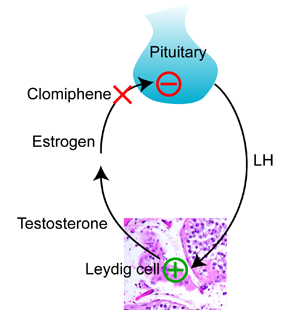
To understand how clomiphene works, you need to know how the pituitary controls the making of testosterone in the testis. Testosterone is made by Leydig cells in the testis, which I explained in my last post. The pituitary releases a hormone called luteinizing hormone (“LH”) that stimulates the Leydig cells to make testosterone. Testosterone is converted to the female hormone estrogen, (which I also explained in my last post,) and estrogen tells the pituitary to stop making more LH. This kind of negative feedback system is common when it comes to how hormones work. It’s just like a thermostat and heater. As the room gets warmer, the thermostat sends less electricity to the heater. When the room gets colder, the thermostat sends more electricity to the heater.
Clomiphene works by blocking estrogen at the pituitary. The pituitary sees less estrogen, and makes more LH. More LH means that the Leydig cells in the testis make more testosterone.
As I explained in my last post, giving testosterone to a man does just the opposite. The pituitary thinks that the testis is making plenty of testosterone, and LH falls. As a result, the testis stops making testosterone, and the usually high levels of testosterone in the testis fall to the lower level in the blood.
So clomiphene is a way to increase testosterone in the blood and the testis at the same time. It preserves testis size and function while increasing blood testosterone.
Unfortunately, clomiphene is not FDA approved for use in the male. Like most of the medications that we use to treat male fertility, the pharmaceutical company that originally sought approval by the FDA did it for women. Clomiphene is now generic, and it’s unlikely that anyone will pony up the hundreds of millions of dollars necessary to get it approved for the male. That’s the bad news. The good news is that it means that this medication is fairly inexpensive, cheaper than most forms of prescription testosterone. Can a doctor prescribe clomiphene for a man? Yes. It’s “off label”, meaning that it’s not FDA approved for use in men.
As a medication, clomiphene is usually well tolerated by men. In my experience, most patients don’t feel anything as their testosterone rises. Those that do feel an increase in energy, sex drive, and muscle mass, especially if they work out. Very rarely I’ve had patients report that they feel too aggressive, or too angry. Very very rarely (twice in the last 20 years) I’ve had patients report visual changes. That’s worrisome, as the pituitary is near the optic nerve in the brain, and visual changes suggests that the pituitary may be changing in size. Because the skull is a closed space, it’s alarming if anything in the brain changes in size. In the last twenty years, I’ve also had two patients who had breast enlargement (called “gynecomastia”) while using clomiphene. Needless to say, for any of these problematic side effects, the clomiphene is discontinued.
So that’s the story with clomiphene. It can be used in the male, either for fertility or low testosterone levels. It’s an off label prescription drug. It works, and is usually well tolerated by men who take it.